








What a Flat Fee Family Law Attorney Costs and Covers
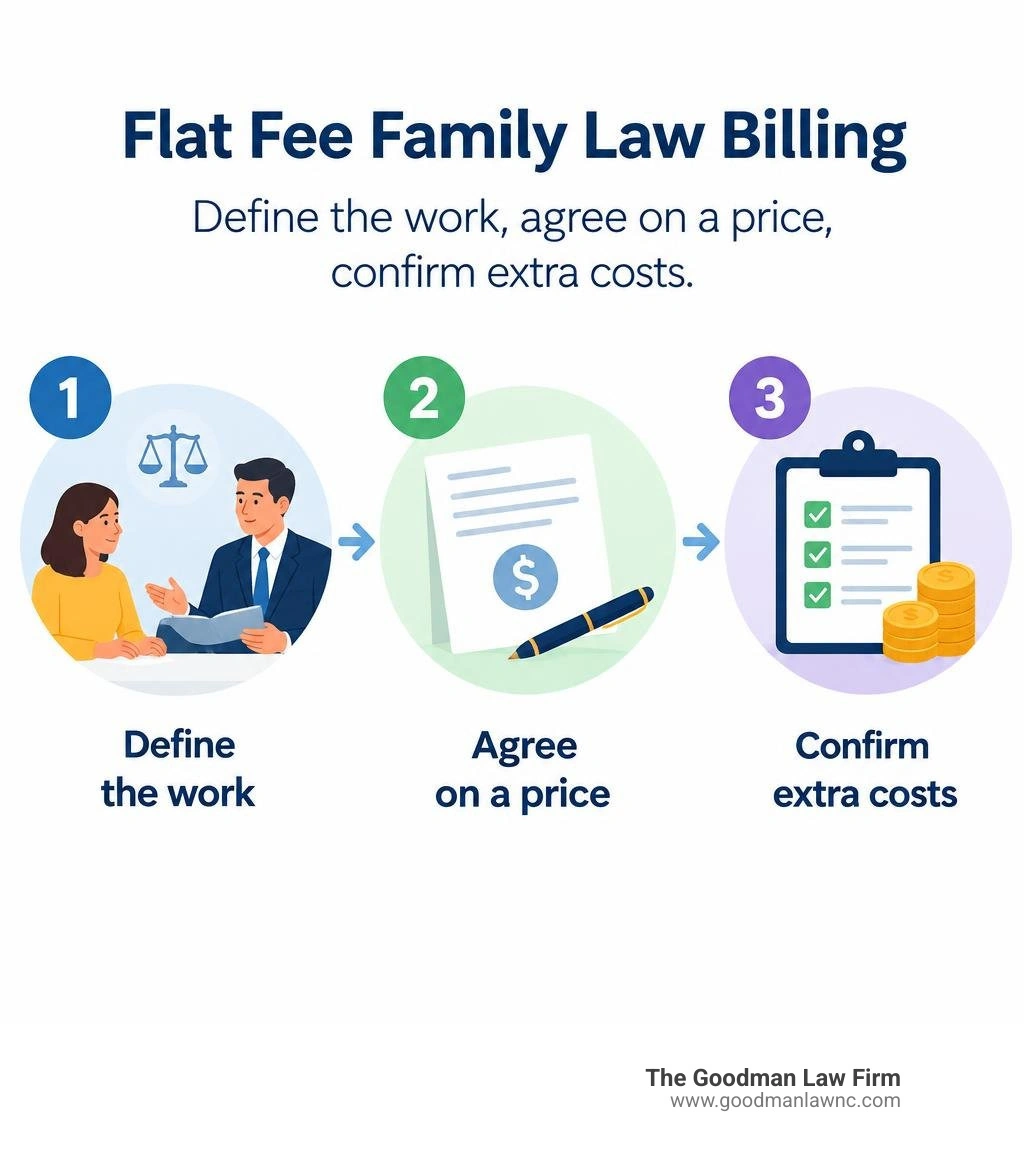
A flat fee family law attorney charges a set price for defined legal work instead of billing by the hour. That can make the cost of a divorce or custody matter easier to plan for. But a flat fee is not always the total cost of your case. Before signing, ask which tasks are covered, which expenses are extra, and what happens if the case becomes contested.
I’m Kara Goodman, founder of The Goodman Law Firm in Charlotte. After more than 15 years working in family law, I know how important it is to understand the scope of legal help you’re paying for, whether you’re speaking with a flat fee family law attorney or reviewing another fee arrangement.
Why Hire a Flat Fee Family Law Attorney Instead of Paying Hourly Rates?
When navigating a domestic legal issue, financial uncertainty can feel just as heavy as the emotional strain. Traditional hourly representation requires putting down an upfront retainer from which your lawyer bills time in six-minute increments (0.1 of an hour). A brief phone call, an email reply, or minutes spent organizing paperwork all deduct from that balance. When the retainer balance depletes, you must replenish it—leading to unpredictable monthly invoices.
Hiring a flat fee family law attorney replaces this uncertainty with defined pricing. You know upfront what specific stages or tasks will cost, allowing you to manage your legal budget without dreading every communication.
| Feature | Flat Fee Representation | Traditional Hourly Retainer |
|---|---|---|
| Billing Model | Predetermined fixed price per task or stage | Billed in 6-minute increments (0.1 hour) |
| Cost Predictability | High; total legal fee is defined upfront | Low; total cost depends on time spent |
| Retainer Depletion | Single payment or scheduled milestone installments | Ongoing replenishment as funds are billed |
| Invoicing Surprises | Minimal; extra costs occur only if scope expands | Frequent; unexpected motions or calls add up |
| Best Suited For | Uncontested matters, document drafting, targeted tasks | High-conflict litigation with unpredictable timelines |
While fixed fees bring clear cost control, they are not a one-size-fits-all solution. In complex litigation with heavy discovery and uncertain court dates, estimating total time accurately is challenging, which may make standard hourly representation or phased flat-rate milestones more practical. Learning how an attorney can help during the divorce process clarifies which billing structure aligns best with your specific legal goals.
Core Services and Cost Breakdowns for Flat Fee Legal Representation
Flat fee models work across a wide variety of family court matters, from discrete document drafting to full-scope representation.

Common domestic matters handled through fixed-fee structures include:
- Uncontested Divorces: When spouses agree on all terms, flat fees often cover drafting the complaint or petition, acceptance of service, and entry of the final judgment.
- Separation and Property Settlement Agreements: Drafting comprehensive, legally binding contracts resolving asset distribution, debt allocation, and spousal support.
- Child Custody and Parenting Plans: Creating formal parenting schedules, holiday allocations, and decision-making frameworks.
- Premarital and Postmarital Agreements: Negotiating and drafting prenuptial and postnuptial contracts to establish asset division expectations.
- Limited-Scope (Unbundled) Services: Retaining counsel for specific tasks, such as reviewing an agreement, coaching you for a negotiation session, or drafting a single motion.
For residents in Charlotte seeking transparent representation, accessing affordable family law services in Mecklenburg County ensures skilled advocacy without surprise billing. If cost is a significant barrier, you can also explore community support options such as Mecklenburg County Family Legal Aid & Pro Bono Services.
Choosing the Right Level of Family Law Support
Every family law matter brings unique dynamics. A simple uncontested divorce between spouses with no minor children and modest shared property requires far less time than an estate involving contested business valuations or complex custody arrangements.
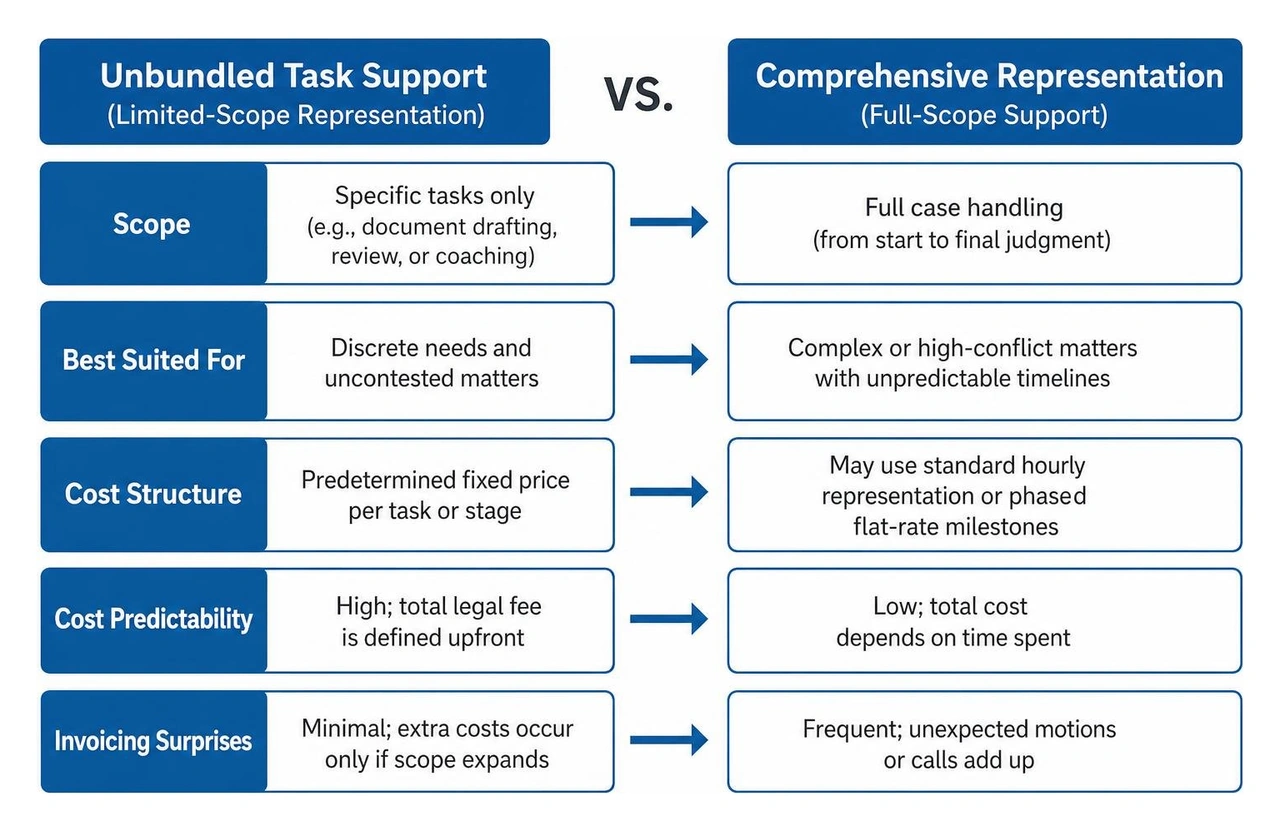
Evaluating your circumstances helps in determining whether you need an attorney for every stage or if focused, limited-scope guidance provides adequate protection.
When to Hire a Flat Fee Family Law Attorney for Your Case
Flat fee arrangements are especially advantageous when conflict is low and outcomes are largely agreed upon. If you and your spouse have aligned on how to divide marital assets, handle retirement accounts, and share parenting schedules, fixed-rate representation ensures your paperwork meets state statutory standards without unnecessary litigation expenses.
Even when communication is smooth, evaluating your case if you and your spouse agree on everything remains a smart safeguard. A lawyer ensures your settlement correctly waives future claims, avoids hidden tax issues, and remains enforceable over time.
Understanding Scope: What Is Included, Excluded, and Handled as Out-of-Scope
A flat fee contract is built around an explicit "scope of representation." This document defines what duties your counsel will perform for the agreed price.

Typical Inclusions
- Direct attorney consultations related to the covered matter
- Gathering information and drafting core legal pleadings
- Exchanging and reviewing required financial disclosures
- Revisions within reasonable limits
- Finalizing court filings or settlement executions
Common Exclusions and Third-Party Costs
Flat fees cover legal labor, but they rarely include out-of-pocket court disbursements or third-party professional fees. Budgeting for these additional expenses is important:
- Court Filing Fees: Required administrative fees paid directly to the court clerk.
- Service of Process: Fees paid to the sheriff or a private process server.
- Third-Party Experts: Costs for real estate appraisers, forensic accountants, pension valuators (QDRO drafters), or private mediators.
Managing Scope Creep
When an amicable agreement hits an unexpected roadblock—such as a sudden dispute over retirement accounts or custody schedules—additional legal work falls outside the initial scope. In these instances, attorneys handle out-of-scope tasks through supplemental flat-rate packages, staged retainers, or an hourly rate for litigation.
To explore how these boundaries apply to specific domestic matters, review our full range of family law services.
How to Vet and Select the Best Representation for Your Matter
Selecting legal representation requires confirming experience, communication style, and fee transparency. A clear contract protects both you and your attorney by establishing shared expectations from day one.
Before attending your initial consultation, take time to organize relevant financial documents, prior agreements, and specific questions. Knowing what to bring to your initial family law consultation ensures you receive an accurate scope assessment and quote. If you reside nearby, consulting a local Matthews family lawyer with affordable rates offers convenient, strategic advocacy tailored to regional court rules.
Essential Questions to Ask a Flat Fee Family Law Attorney
- What specific tasks are covered under this flat fee? Ask for an itemized list of covered drafting, revisions, and court appearances.
- What costs are excluded? Confirm how court filing fees, process service, and mediation charges are billed.
- What happens if our uncontested matter becomes contested? Ask how additional negotiations or unexpected court motions are priced.
- How are communication and updates handled? Clarify whether emails, calls, and case reviews are fully included in the fixed fee.
- Are payments broken into stages or milestones? Inquire about payment schedules or deposit requirements.
Frequently Asked Questions About Flat Fee Legal Services
What happens if an uncontested case becomes contested under a flat fee?
If negotiations stall and your spouse contests terms, the matter transitions beyond the uncontested scope. Your attorney will present options to expand the agreement, such as adding a mediation package, charging a fixed fee per contested court stage, or shifting to an hourly model for litigation.
Are court filing fees and third-party expenses included in the flat rate?
Generally, no. Flat fees cover attorney services and legal drafting. Hard costs—such as court filing fees, sheriff service, and private mediator expenses—are separate disbursements paid directly to the court or third-party providers.
How do retainer payments and payment plans work with flat fees?
Many firms require payment upon signing the client agreement, while others offer structured milestone plans (for example, a deposit upon engagement and the remainder upon final draft completion). Always review your engagement contract to understand payment timelines and refund terms.
Conclusion
Navigating divorce, separation, or custody changes is challenging, but your legal expenses shouldn't be an unpredictable burden. Transparent fee structures provide peace of mind, allowing you to focus on building a stable future for your family.
At The Goodman Law Firm, we combine over 15 years of focused family law experience with compassionate, strategic advocacy designed to resolve disputes efficiently. When parenting schedules and decision-making authority are at stake, securing dedicated child custody legal counsel protects your parental rights and your children's well-being. Contact us today to discuss your case and find the right path forward.
We’re Here When You Need Us
Family law challenges can feel overwhelming, but you don’t have to face them alone. Let’s talk. Reach out today, and let’s take the next step together.